
Speaking first
70% of every class is conversation. Speaking badly is the compulsory step towards speaking well, and nobody judges you here.
My method has a rather untechnical name: speaking for real from day one. It is based on the communicative approach — the one backed by research on language acquisition — but adapted to what I, Vladimir Alejandro Urtecho Ortiz, experienced first-hand as a Spanish speaker learning English as an adult, between Managua and Málaga.
Grammar matters, of course. But you learn it by using it in real conversations, not by filling in lists of exercises you forget the next day. Every new structure appears inside a situation you care about, gets practised out loud, and comes back in the following weeks until it flows on its own. That's how memory works: through use and spaced repetition, not through cramming.
And there's a third ingredient almost no method mentions: the student's emotional state. A relaxed, motivated adult learns twice as much as a tense one. That's why the first job of every class is making you feel comfortable; everything else comes after.

Everything we do in class rests on these four principles. If one day an activity doesn't fit any of them, it comes out of the plan — simple as that.
70% of every class is conversation. Speaking badly is the compulsory step towards speaking well, and nobody judges you here.
We simulate interviews, phone calls, trips and meetings. You leave class with phrases you'll use that very week.
Every structure is learned inside a situation, with specific tips for Spanish speakers.
Quarterly goals, regular reviews and recordings so you can hear your own evolution.
Do you "know" English on paper but freeze when you have to speak? It has a name: language anxiety, and it's the number one obstacle for Spanish-speaking adults. It's not a lack of level: it's the fear of sounding ridiculous, of the sentence coming out "wrong", of disappointing someone. That fear sets off an alarm in the brain that literally blocks access to the vocabulary you do have.
My method attacks it head-on, because I suffered it myself. First, we normalise mistakes: in my classes an error is never penalised — it's celebrated as raw material. In fact, I note down your mistakes more lovingly than your successes, because they're the map of your next breakthrough. Second, you start speaking in an environment with no audience and no judgement, on topics you know well. Third, we raise the difficulty so gradually that the panic zone never gets switched on.
The result repeats itself student after student: somewhere between week 4 and week 8, one day you catch yourself answering in English without having mentally "prepared" the sentence first. That day, anxiety loses the battle. And from then on, everything speeds up.
If you recognise yourself in this block, know two things: you're not a lost cause — it's the most common student profile I receive — and it isn't cured by "just pushing through", but with an environment designed to switch it off. That's exactly what you'll find in my classes.

So you know exactly what to expect. Sixty minutes that fly by — everyone tells me so.
Free conversation about your week. No script, just like real life.
New structure or vocabulary, presented with useful examples.
Role-plays and guided conversation using what you've learned. This is where the magic happens.
Review of key mistakes, an optional mini-task and the plan for the next class.
Look at the proportions: out of the 60 minutes, you spend more than 40 actively speaking or listening to English, and not a single minute filling in worksheets in silence. You can do that at home for free; the class is for what you can't do alone. Every quarter, we also dedicate one session to reviewing your progress: we compare a current recording of you with one from three months earlier, go over the goals we set and adjust the plan. Hearing yourself speaking better is the most powerful motivation I know — far more than any grade.
There's a myth that a native teacher is always the best option. My experience — and that of thousands of learners around the world — says otherwise: for a Spanish-speaking adult, a bilingual teacher who learned English as a second language has enormous advantages, especially at beginner and intermediate levels.
Think about it: a native speaker never had to learn the difference between "make" and "do" — it came pre-installed. I did. I remember exactly what confused me, which trick solved it and in what order things are best learned. I can explain a grammatical nuance to you in Spanish in two minutes that would take twenty in English, and I can anticipate your mistakes before you make them — because they were mine.
And I'm living proof that it can be done: nobody handed me my English. I built it through years of work between Managua and Málaga, and that gives me something no certificate teaches — real empathy with the person in front of me. When you get stuck, I don't get impatient: I recognise myself.
The two weekly hours of class are the engine, but the fuel goes in during the week. These four short routines multiply your progress.
10 minutes a day of active listening: a podcast at normal speed, a scene from your series with English subtitles. The key is frequency, not duration — the ear is trained like a muscle, with consistency.
Listen to a sentence, pause it and repeat it out loud, imitating the rhythm and intonation like an echo. Five minutes of shadowing do more for your pronunciation than an hour of phonetics theory. I give you audio clips prepared for exactly this.
No lists of isolated words: write down complete sentences you could actually use. "I'd rather meet on Thursday" is useful; "rather = más bien" is not. Review them twice a week and use them in the next class.
Each week I set you a 15-minute task connected to what we've learned: a real email, a voice note telling me about your weekend, a restaurant review. I correct everything with comments, not with red ink.
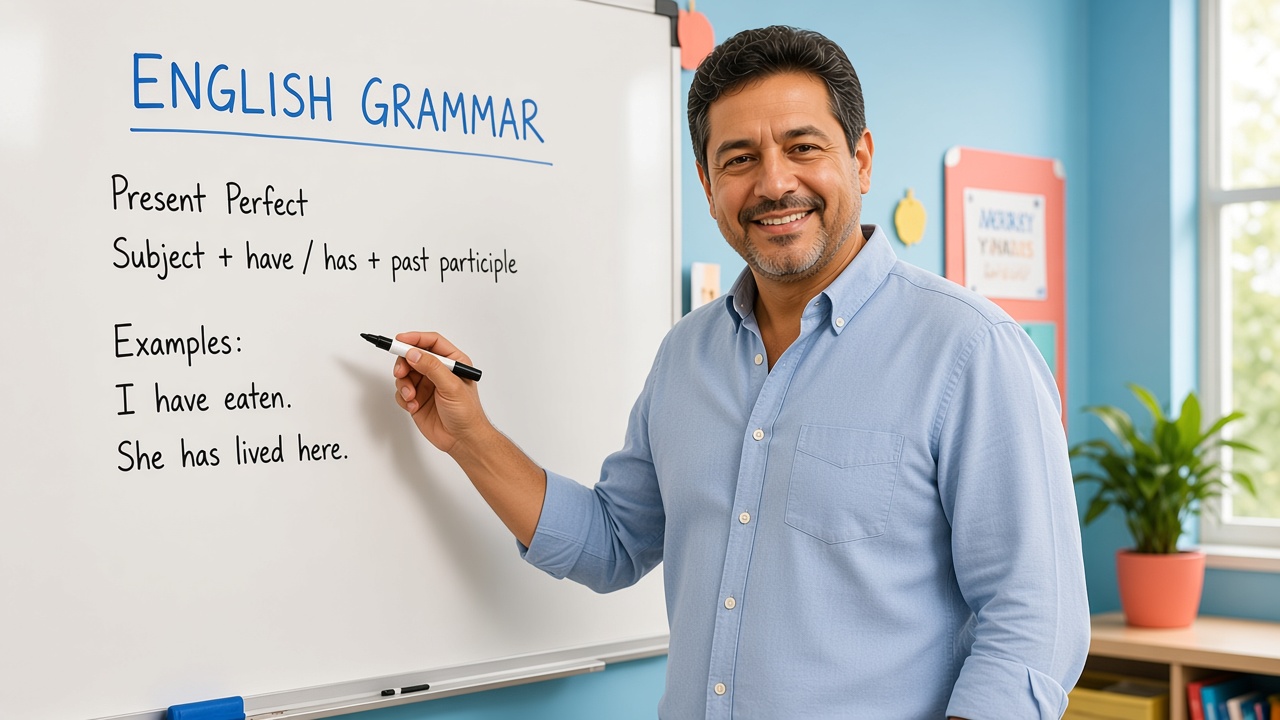
Publishers' generic materials are written for "the average student of the world" — who doesn't exist. Mine are written for one specific person: the Spanish-speaking adult learning English. All my students receive them at no extra cost:
I keep updating them with what I see in class: if three students trip over the same thing in a month, that stumble ends up as material for everyone. The method learns too.
I want to startTheory is all very well, but methods are judged by their results. Three of Vladimir Alejandro Urtecho Ortiz's students tell it better than he can.
I came from an academy where I didn't get past the present perfect in two years. With Vladimir I spoke more English in the first month than in those two years. His trick of noting my mistakes and turning them into the warm-up of the next class is pure gold.
I was one of those who froze. In the first classes Vladimir let me switch to Spanish when I got stuck, and without noticing I needed it less and less. I never felt embarrassed — and at 52, starting from zero, that is priceless.
What surprised me most was the follow-up: every quarter we listen together to my recording from three months back. The first time I nearly cried — I couldn't believe that was me. Now I work at a German company and my day-to-day is in English.